Edition 57 · 11/10/2026

How Ayurveda Can Restore Your Emotional Balance?

Curated by Lucas Campos · Ayurvedese®

Share:
In this edition, we explore how Ayurvedic practices are proving effective in emotional and physical recovery, especially after challenging experiences like COVID-19. The use of techniques such as Shirodhara highlights the importance of self-care and mental balance, while innovative treatments for conditions like venous ulcers demonstrate Ayurveda's adaptability to individual needs. Additionally, research on Tamra Bhasma reminds us of the relevance of personalization in treatment, essential for harmonizing the doshas and promoting well-being. Let’s reflect together on how these practices can transform our health and lives. — Lucas
Shirodhara and the Relief of Anxiety and Depression Post-COVID: A Case Study
jaim

Shirodhara and the Relief of Anxiety and Depression Post-COVID: A Case Study

Researchers have demonstrated that Shirodhara therapy can be a valuable addition in the treatment of post-COVID anxiety and depression. The case study, conducted by Manoj Shamkuwar and collaborators, observed a patient who, after COVID-19 infection, exhibited significant symptoms of anxiety and depression. The application of Shirodhara, which involves the application of warm oil on the forehead, resulted in a notable reduction of symptoms, improving the patient's emotional well-being. The authors highlight that this Ayurvedic technique can act on the nervous system, promoting relaxation and emotional balance, which is crucial for the recovery of patients facing the psychological consequences of COVID-19. Although the results are promising, it is important to consider that this is a case study, which limits the generalization of the findings. More research is needed to validate these results in larger populations with different clinical profiles.
Read full →

Minimally Invasive Ayurveda Treatment for Recurrent Venous Ulcers: A Case Report
pubmed

Minimally Invasive Ayurveda Treatment for Recurrent Venous Ulcers: A Case Report

Researchers reported a case of chronic non-healing venous ulcer treated with a minimally invasive Ayurvedic approach. The patient, with a history of recurrent ulcers, showed significant improvement after the application of therapies such as leech therapy and the use of specific herbs. The treatment focused on promoting healing and reducing pain, demonstrating the efficacy of Ayurveda in conditions that are often challenging in conventional medicine. The authors, Santhi Krishna AS, Eranezhath S, and Namboothiri AT, highlight the importance of customizing treatment according to the patient's profile, considering factors such as dosha and overall health status. Although the report presents positive results, limitations such as the lack of a control group and the small number of cases should be considered.

Read full →

Tamra Bhasma: comparison between the classical and modified forms in toxicity, antimicrobial action, and antioxidant activity
pubmed

Tamra Bhasma: comparison between the classical and modified forms in toxicity, antimicrobial action, and antioxidant activity

Researchers evaluated the acute toxicity, antimicrobial properties, and antioxidant properties of Tamra Bhasma, a copper-based Ayurvedic medicine, in its classical and modified versions. The study, conducted by Nille GC and collaborators, revealed that the modified form exhibited lower oral toxicity compared to the classical form, as well as superior efficacy in antimicrobial and antioxidant activity tests. The results suggest that modifying the preparation process may enhance the safety and efficacy of Tamra Bhasma, aligning with Ayurvedic principles of adjustment and personalization of treatments. However, limitations such as sample size and the need for more clinical studies were highlighted, indicating that further research is necessary to validate these findings in broader clinical contexts.

Read full →

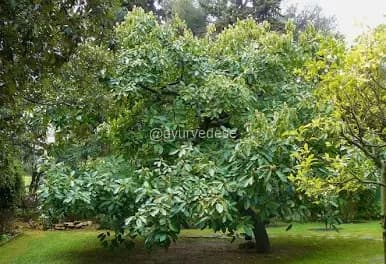
Abacateiro

Herb of the day

Abacateiro

Persea americana

O abacateiro é a árvore da espécie *Persea americana*, da qual se usam as folhas como erva. Seu uso vem da tradição popular brasileira, não dos textos clássicos do Ayurveda. Pela leitura ayurvédica, a folha é tida como diurética (mūtrala), calmante de pitta e anti-inflamatória. Na tradição popul…

View in catalog →

Sloka of the day

यथा नद्यः स्यन्दमानाः समुद्रेऽस्तं गच्छन्ति नामरूपे विहाय। तथा विद्वान्नामरूपाद्विमुक्तः परात्परं पुरुषमुपैति दिव्यम्॥

Just as flowing rivers dissolve into the ocean, abandoning name and form — so the sage, freed from name and form, attains the supreme divine Puruṣa, beyond that which is beyond.

prashna 6.5

The Praśna Upaniṣad offers a classic image of liberation: rivers entering the ocean, dissolving their "names" (Ganges, Yamuna) into uniformity. The sage too dissolves his limited identity (nāma-rūpa = name-form) into something vaster. Important principle: liberation is not "going elsewhere"; it is "returning to the origin by losing separation". Contemplative application: meditations that visualize dissolution into something greater (ocean, infinite space) operate on this principle. The point is not the visual technique; it is the recognition that separation was illusory.

To practice today

Dedique alguns minutos hoje para meditar sobre sua conexão com o todo. Sinta-se parte do oceano da vida!

Podcast episode

#61 - Tradição dos 18 Siddhas e o Kriya Yoga De Babaji (feat. Maitreya)

Neste episódio falamos sobre a tradição dos 18 Siddhas e o Kriya Yoga de Babaji, com o amigo e Kriya Yoga Acharya Maitreya. Quer saber mais? Acesse: https://lnk.bio/ayurvedese …

Listen on Spotify
Share: